
Meaghan Mitchell on trauma at a 22-Fillmore stop and the long road to forgiveness
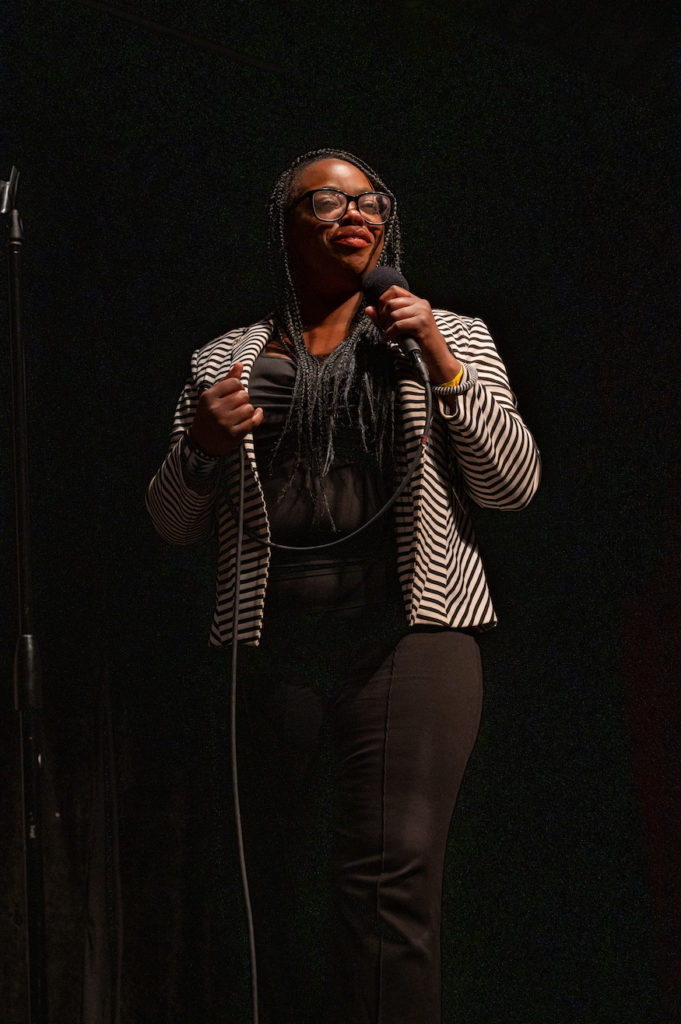
We’re back on the storytelling tip with San Francisco native and San Francisco Standard journalist Meaghan Mitchell—first at Muni Diaries Live in April, and now on the podcast. Meaghan shared a life-changing experience from her youth at a 22-Fillmore stop that touches on summer love, physical trauma, her identity as a Black woman, and more.
We’ve long been proud of the fact that Muni Diaries stories range from sweet and quirky, to weird and funny, to powerful and deeply personal. This is no exception, as we were invited to lean into the vulnerable and, at times, uncomfortable story with Meaghan as she shared with us that night.
tw: violence against women
Listen to her story:
You can also watch the story below:
Meaghan had our tear ducts working a few years ago, when she told a different story at Muni Diaries Live about an especially rough day at school, playing hooky as a result, and the way Muni featured prominently—and personally—into the experience.
Keep up with Meaghan on Twitter @meaghan_m, and send any and all flavors of transit stories or tales of city life to munidiaries.sf@gmail.com or @munidiaries on all the socials.
Photo by Amanda Roosa. Video by Maya Curry.
Hi Meaghan,
I just listened to your assault on Muni Diaries Podcast.
I’m really sorry that happened to you. What a horrific and traumatic event to experience.
I’m happy that you’ve moved forward and that you were able to share your experience with others.
I experienced (directly and indirectly) racists and a homophobic slur and being spit at by the same individual on the 38 Geary in the past 7 months (late 2022 and early 2023) on two different occasions.
The Egg Thrower (Joseph Benjamin). He’s made the news for assaulting (spitting on) a Muni bus driver and a writer from New York. She had eggs thrown at her.
I informed the SFDA about what I experienced on the #38 about three months ago. Long story for this space. He took out a screwdriver about 12″ long and was pointing it at and threating/intimidating Asian seniors with it. We made eye contact. I had mace. I didn’t know what the hell to do. Long story.
When I go to work the first person I look for @ Jones & Geary is that individual. I will not board the bus when he gets on or if he’s at the bus stop. He’s supposedly banned from the #38 and another bus line. I haven’t seen him for about a month or two now.
I wish you the best. Take care and be safe.
Meaghan Mitchell shares a profound and courageous story, reminding us that Poor Bunny painful memories can also become a path to healing and forgiveness.
Investing in offensive linemen Retro Bowl and receivers early can make your offense nearly unstoppable.
baseball 9 is an exciting, realistic sports game about baseball. Become the manager of a professional baseball team and lead your team to victory, competing in higher-level tournaments.
This story highlights how personal narratives can hold multiple layers at once—memory, identity, place, and emotional aftermath all intersecting in a single experience. What stands out is how storytelling becomes a way to organize something that is otherwise fragmented and difficult to fully explain. That process of uncovering meaning step by step is similar to wordle unlimited, where understanding gradually forms as each clue reveals a small but important part of the bigger picture.
The piece emphasizes that recovery and forgiveness are not linear processes, but long and uneven journeys shaped by time, reflection, and support. What happened at that 22-Fillmore stop is not treated as a single moment, but as something that continues to echo through different stages of life. That sense of navigating instability while moving forward resembles slope 2, where maintaining balance under shifting conditions requires patience, focus, and persistence.
One of the most striking aspects of the story is the resilience embedded in continuing forward after trauma, especially when identity and lived experience add additional layers of complexity. The idea of rebuilding strength over time, even when progress feels uneven, is central here. That gradual restoration of rhythm and control is similar to speed stars, where performance depends on endurance, timing, and steady recovery after disruption.
This narrative also shows how powerful spoken storytelling can be when it is shared in community spaces like live events and podcasts. The combination of voice, memory, and audience presence transforms personal experience into something collective and deeply felt. In a broader sense, this kind of storytelling can also be expanded through modern creative tools like nanomaker, which explore how AI-generated media can help preserve and reimagine personal and cultural narratives in new formats.
What makes this piece impactful is not only the individual story, but also the environment around it—how community platforms give space for voices that might otherwise remain unheard. The act of sharing and listening becomes a form of collective support, where each story contributes to a larger social field. That dynamic resembles the cooperative structure seen in baseball bros unblocked, where coordination and shared effort shape the outcome more than any single action alone.
The storytelling format here relies heavily on trust between speaker and audience, allowing difficult experiences to be expressed without losing nuance or humanity. That balance between vulnerability and structure is what makes the narrative resonate so strongly. It reflects a kind of emotional spacing and timing similar to basketball bros, where movement and awareness work together to create flow and understanding within a shared space.
That story about the 22-Fillmore stop really stuck with me, especially how it ties together trauma, summer love, and what it means to move through the world as a Black woman. The long road to forgiveness feels so real here — honestly, it has that same haunting, hard-to-shake feeling as Pokemon Lazarus, where you’re left sitting with something heavy long after it’s over.